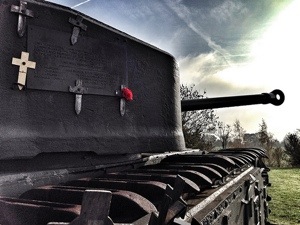
It has certainly been a busy 2013. I started the year having just taken over as Head Battlefield Guide for the entire Leger Holidays range of battlefield tours, having previously been just responsible for their WW1 programme. This new development was about to take me on a very long journey which by the close of the year saw me travel over 35,000 miles around Europe visiting sites from the two World Wars.
Having a free hand to develop the Leger range of tours meant revisiting what we already did and bringing much of it up to date. This began with a couple of weeks travelling round Europe following the story of the Holocaust, a particularly poignant one for me as my grandmothers French family died in Auschwitz in 1944. From here I moved on to a whole scope of WW2 battlefields in Belgium, France, Holland and Germany, and it was great being able to share these many travels with friends and followers on Twitter.
While working on the WW2 tours I also had one eye on the Great War as the WW1 Centenary drew close. Aside from bringing in the obvious 1914 related tours I wanted to use the centenary to tell the wider story of WW1 and developed the ‘Western Front End to End’ tour which over seven days would take travellers along all 450 miles of the Western Front getting a greater concept of its geography and that the war was more than just the Somme and Passchendaele. It proved to be one of our best-selling tours for 2014, which was pleasing.
Outside of battlefield tours a lot of work for 2013 revolved around TV projects in preparation for the WW1 Centenary. Highlights included working on all four episodes of Jeremy Paxman’s BBC flagship WW1 series with a range of producers and production staff, all keen to do a good job and not to re-tell just the obvious WW1 stories, which was refreshing. This TV work continued off and on all year with a trip to Flanders in December to be filmed by 360Production for a programme about Ireland in the Great War.
Work on my own books has been slack for 2013 but I have almost completed a new edition of Walking Ypres and have started work on some eBooks for 2014. It’s been good to see some friends bring their own books to a finish, with Alex Churchill’s book on Etonians in WW1 soon to come out. Good friend Professor Peter Doyle has been very prolific this year with his Remembering Tommy being one of my favourite books of the year for not only its quality but superb production values making it a handsome book to own in every respect.
Twitter and Blogs have kept me busy in 2013. With over 8,500 followers as the year comes to an end I’m pleased and excited by the way history has developed onTwitter, and really enjoy interacting there sharing travels, photos and knowledge, and often learning so much myself, which is fantastic. Great War Photos has gone from strength to strength with over a quarter of a million unique visitors since it opened and my WW1 Centenary blog getting more and more visitors. Both of these will be very active indeed during 2014.
Next year I might not do as many miles, but with the anniversaries of both 1914 and 1944 to look forward to it, it is likely to be even busier, if that is possible! Next year is a wonderful time to spread knowledge, enthusiasm and also educate, and while the dissenting voices about the WW1 Centenary do grow – and I have some fears myself – I hope many will take it as a great opportunity to do all these things and more.
See you on the battlefields!
 The Longest Day by Cornelius Ryan (Carlton Books 2014, ISBN 9780233004136, fully illustrated, audio CD & enclosures, £50.00)

 Over many periods of
 Somme Intelligence, Fourth Army HQ 1916 by William Langford (Pen & Sword Books 2013, ISBN 9781781590829, 160pp, illustrated throughout, £19.99)
 The Marne 1914: A Battlefield Guide by Andrew Uffindell (Pen & Sword Books 2013, ISBN 978-1-84884-801-6, 215pp, Illustrated throughout, maps, £15.99)


 Out of Battle